


Why Prop Traders Prefer Micro Futures for Funded Accounts
- Ankit Gupta
- September 5, 2025
Introduction: The Connection Between Prop Trading and Micro Futures
If you’ve been looking into prop trading, you already know that most funded accounts come with rules. These rules aren’t there to limit you; they’re meant to protect you. For many traders, the challenge isn’t finding opportunities in the market – it’s staying within the firm’s risk guidelines. That’s exactly where micro futures come in. They allow you to trade popular indices like the S&P 500 or Nasdaq without putting your entire account at risk on a single move.
Understanding Micro Futures in Simple Terms:
Think of micro futures as a smaller version of regular futures contracts. Instead of controlling a large position that can move your account balance by hundreds of dollars on a single tick, micros allow you to cut that position size down to a fraction. An E-mini S&P 500 contract, for example, may feel too big if your account is $50,000. However, the Micro E-mini S&P 500 contract allows you to participate in the same market with 1/10th of the size.
In day-to-day trading terms, it is like getting to play the same game but with a level of risk where mistakes do not cost you everything. For prop traders, having that extra level of room before blowing up can be the difference in successfully passing their challenge or blowing up within the evaluation period.
Why Prop Firms Offer Funded Accounts and the Role of Risk Management
Prop firms exist because they balance two things: giving traders access to capital and protecting that capital from being wiped out. When you get a funded account, you’re expected to stick to rules like daily loss limits, maximum drawdown, or position size restrictions. These aren’t roadblocks – they’re safety nets.
Now, micro futures naturally fit into this model because they lower the risk of big swings. If you’re trading a full-size contract and the market makes an unexpected move, you might hit your loss limit with one bad trade. Micro futures for prop traders allow you to take that same trade idea but scale it down, making it easier to stay within the rules while still proving you can trade consistently.
How Micro Futures Benefit Prop Traders
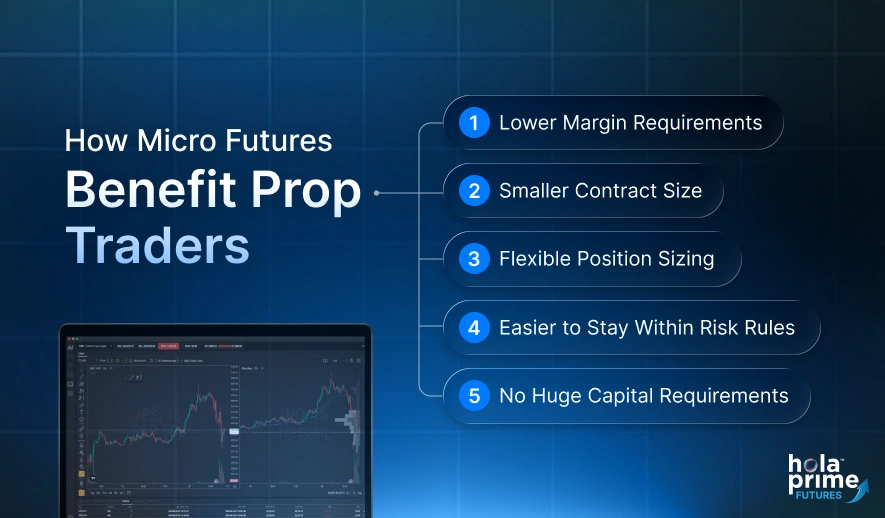
1. Lower Margin Requirements Mean Easier Access
With micro futures, you don’t need as much capital to open a position. For example, margins can be a fraction of what you’d need for an E-mini. That means even if you’re trading a smaller funded account, you still have access to major markets without over-leveraging.
2. Smaller Contract Size Reduces the Pressure
Every tick in a standard futures contract can feel heavy. With micro futures, the value of each tick is smaller, so the swings don’t throw your emotions all over the place. This helps traders keep a clear head, which is often half the battle in trading.
3. Flexible Position Sizing Helps with Strategy
Micros give you more control. Instead of going all-in with one contract, you can scale in or out gradually. For example, you can take two or three micros, close one for partial profit, and let the others run. That flexibility is hard to manage with larger contracts.
4. Easier to Stay Within Prop Firm Risk Rules
Most funded accounts have strict drawdown or daily loss rules. Micro futures naturally make it easier to respect those limits because your exposure is smaller. Instead of worrying about one bad tick costing you your evaluation, you can manage risk in a more controlled way.
5. Access to Major Indices Without Huge Capital Requirements
This is one of the biggest appeals. With micro futures, you can still trade big names like the S&P 500, Nasdaq, or Dow Jones – markets that move the world – without needing a huge account balance. You get exposure to the same opportunities, but on a scale that works for prop-funded accounts. Traders can have more capital efficiency with micro futures.
Advantages for Prop Firms Themselves
From the firm’s point of view, allowing traders to use micro futures reduces their risk, too. A trader who can manage risk with smaller contracts is less likely to burn through a funded account quickly. It also attracts more traders, especially beginners who want to prove their skills without the fear of blowing up on one contract. So in many ways, it’s a win-win: the trader gets breathing space, and the firm gets more stable performance.
Challenges and Limitations Traders Should Still Be Aware Of
That said, micros aren’t a magic solution. One challenge is that traders sometimes overtrade because the contracts feel “cheaper.” Ten micros can quickly add up to the size of a full E-mini, and if you’re not careful, you’re back to the same level of risk.
Another limitation is that while micros reduce the dollar risk per tick, the psychological side of trading doesn’t disappear. Leverage is still leverage, and poor discipline can hurt just as badly. Micros should be seen as a tool – not an excuse to trade without a plan.
Practical Tips for Prop Traders Using Micro Futures
1. Treat Them Seriously, Not as Practice Contracts
Even if the dollar value per tick feels small, trade them as if they matter. The habits you build here will carry over when you move up to larger contracts.
2. Journal Every Trade
When you’re working with a funded account, details matter. Keep track of why you entered, how you managed the trade, and whether you stayed within risk rules. This record can show you patterns you wouldn’t notice otherwise.
3. Start Small and Scale Up Gradually
Don’t jump in with five or ten micros just because you can. Start with one or two, learn how the market moves, then add more if your strategy allows.
4. Focus on Risk Per Trade, Not Just Contract Size
Even if the contract size of the micro E-minis is smaller, they still carry risk. It is always a good idea to calculate the risk per trade and keep that in consideration while trading. If you will risk too much on one trade, there are chances that you might hit the max drawdown limits.
5. Use Micros as a Stepping Stone
Think of micro futures as training wheels for consistency. Once you’ve proven you can manage them profitably within prop firm rules, you’ll have the confidence and record to move into larger contracts.
Real-World Example of Micro Futures in Funded Accounts
Let’s say you’re trading a $50,000 funded account with a $2,500 max drawdown. If you try trading a standard E-mini S&P 500 contract, one bad move could cost you hundreds, maybe even close to your limit. But if you trade micros, each tick is only $1.25. That means you can take trades, follow your system, and build consistency without risking the whole account on one setup.
This is why many prop traders treat micros as a safer and smarter option, especially in the early stages.
Conclusion :
At the end of the day, trading is about staying in the game long enough to build consistency. Micro futures give prop traders that chance by lowering the stakes without taking away the opportunity. They’re not just easier to manage – they’re also better suited for the rules and limits of funded accounts. That’s why more and more traders, whether new or experienced, are turning to micros as their go-to contracts in the prop trading world.
FAQs
1. What’s the main difference between micro futures and mini futures?
Micro futures are one-tenth the size of E-minis, which means each tick is worth less and the margin requirements are lower.
2. Do all prop firms allow micro futures trading?
Not all, but most reputable prop firms now include them because they fit well with funded account risk models.
3. Are micro futures less profitable than standard contracts?
Not necessarily. While the dollar amount per tick is smaller, they let you trade more consistently without breaching rules, which often leads to better results over time.
4. Can I scale from micro futures to larger contracts in a prop account?
Yes, many traders use micros to build consistency and then move on to E-minis or standard contracts once they’ve proven themselves.
5. How do micro futures help with prop firm evaluations?
They make it easier to stay within daily loss and drawdown limits, giving traders a better chance of passing evaluations.
Disclaimer: All information provided on this site is for educational purposes only, related to trading in financial markets. It is not intended as financial advice, business or investment recommendation, or as an opportunity or recommendation to trade any investment instruments. Hola Prime only provides an educational environment to traders, including tools, materials and simulated trading platforms which have data feed provided by Liquidity Providers. The information on this site is not directed at residents in any country or jurisdiction where such distribution or use would be contrary to local laws or regulations.